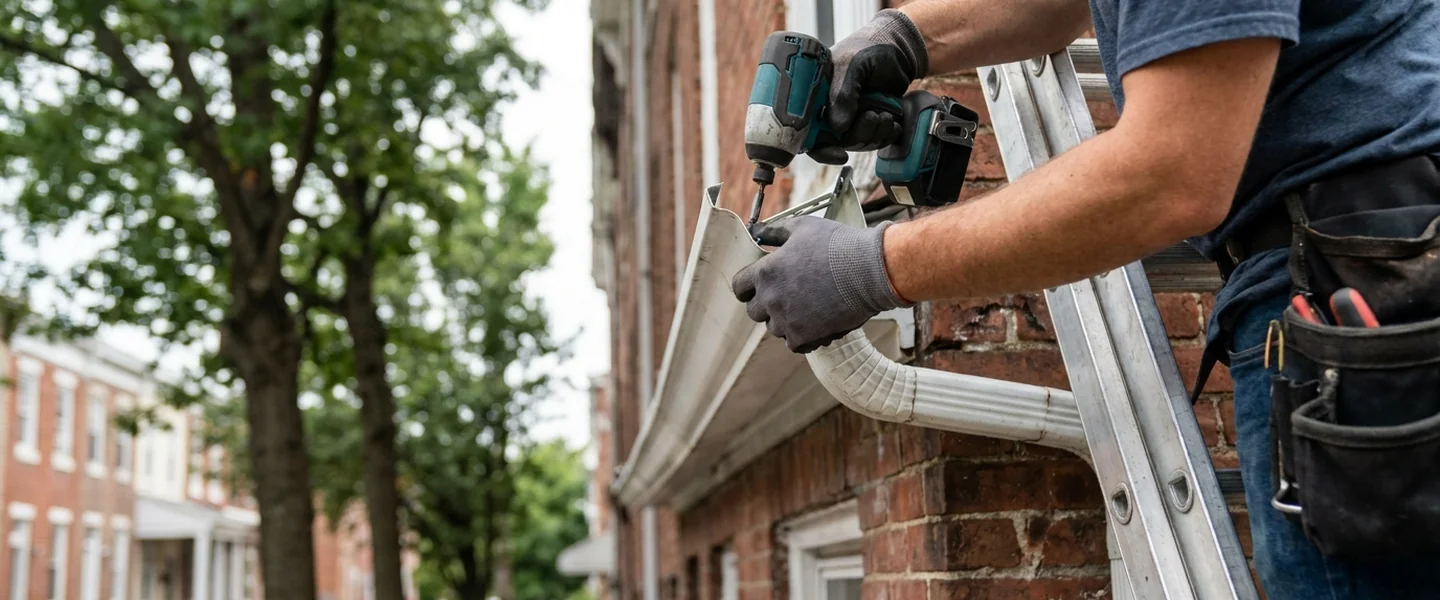
Gutter Repair in Baltimore, MD
Ice dam damage, storm dents, pulled hangers, leaking seams, wood rot — we diagnose and repair every gutter failure type affecting Baltimore homes. Fast response, honest written estimates.
Call (443) 339-6431 — Free EstimateBaltimore Gutter Repair — All Damage Types
Baltimore's climate and housing stock create a specific and predictable set of gutter failure modes. Understanding what went wrong — and addressing the root cause, not just the symptom — is what separates a lasting repair from a temporary patch that fails again next winter. At Baltimore Gutter Experts, every repair begins with a thorough diagnostic inspection so we can give you an honest assessment: whether repair is the right call or whether the cost-effectiveness of replacement makes more sense for your specific situation.
Ice Dam Damage: Baltimore's Most Common Winter Repair
Ice dams form when heat escaping through a home's roof deck melts the overlying snowpack. That meltwater flows down the roof toward the eave, where the soffit overhang is cold enough to refreeze it. As ice builds up at the eave, additional meltwater pools behind the dam and can work its way under shingles, into the attic, and down interior walls. The gutter system suffers considerably in this process — the weight of accumulated ice pulls hangers out of the fascia, bends gutter profiles, tears downspout connections loose, and can pull entire gutter sections off the roofline.
After a particularly cold Baltimore winter — and winters in the 2020s have been erratic, alternating mild and severe — we often see a surge of ice dam repair calls starting in March. The symptoms are unmistakable: gutters hanging at odd angles, visible gaps between the gutter back and fascia board, water staining running down the exterior wall beneath where a gutter should be sealing against the fascia, and in severe cases, completely detached sections.
Repair involves re-securing or replacing hangers, re-sealing the gutter back to the fascia, replacing sections that are bent beyond usable profile, and checking the fascia board itself for rot caused by the sustained moisture exposure. If the ice dam damage resulted from a fascia that was already compromised by rot, the wood must be replaced before the gutter is re-hung — otherwise the new hangers will fail just as quickly as the old ones.
Nor'easter Storm Damage
Major Nor'easters that hit the Baltimore region — and several significant ones have struck in recent years — can deliver sustained 40–60 mph winds with gusts considerably higher. These winds drive rain horizontally, loading gutters that were designed for vertical rainfall, and can tear guards off their mounts, pull improperly secured downspout straps from the wall, and in extreme cases topple entire sections of gutter that were hung without screws into the structural rafter tails.
Post-storm gutter inspection is something we recommend after any event with winds above 40 mph or rainfall that exceeded an inch per hour. The most common storm damage we repair includes: bent or crushed sections from fallen branches, pulled hangers at the leading edges of gutter runs, separated mitered corners at inside and outside angles, and downspouts pulled off the wall or separated at their slip joints.
Leaking Seams and Joint Failures
For homes with sectional aluminum gutters — still common in Dundalk, Catonsville, and older parts of Towson — leaking seams are a recurring problem. The caulk or gutter sealant that holds sectional gutter joints watertight has a finite life, and Baltimore's freeze-thaw cycles accelerate its degradation. When a seam opens, water runs along the gutter's exterior surface toward the fascia rather than flowing to the downspout. Sustained moisture against the fascia board leads to rot, and rot spreads quickly in Baltimore's humidity.
Seam repair involves thoroughly cleaning the joint area, applying appropriate gutter sealant, and allowing it to cure. On older galvanized steel gutters with multiple failing seams, we typically recommend a whole-system replacement rather than repeated seam repairs — at some point the math favors a new seamless system that won't require this cycle of maintenance.
Pulled Hangers and Sagging Gutters
A sagging gutter — one that has developed a low point in the middle of a run — is almost always a hanger problem. Hangers either pulled out of the fascia (often due to rot or inadequate fastener size), bent under heavy ice or debris load, or were spaced too far apart to support the gutter profile. A sagging gutter holds standing water at its low point, which promotes mosquito breeding, accelerates corrosion in steel systems, and adds stress to the gutter profile and nearby seams.
Re-hanging involves locating sound wood in the fascia or rafter tails, installing new heavy-duty hidden hangers at appropriate spacing, and re-pitching the gutter run toward the downspout. If the original hanger failure was due to rotted fascia, the wood is replaced first.
Repair vs. Replacement: Honest Advice
We always tell homeowners honestly when a repair is the right call and when replacement makes more economic sense. A good rule of thumb: if a gutter system has multiple failing seams, widespread hanger problems, sections with irreparable bends or pitch issues, and the underlying fascia has significant rot, full replacement is almost always the better value. The cost of repeated repairs on a failing system can exceed the cost of replacement within a few years, and replacement gives you a 20-year warranty on a system that will perform correctly from day one.
On the other hand, isolated storm damage on an otherwise sound 5-year-old seamless system is a clear repair situation. We'll diagnose honestly, give you the written options, and let you decide.
Frequently Asked Questions
Yes. We can perform most gutter repairs year-round. Caulk and sealant applications require temperatures above freezing to cure properly, so extreme cold days may require rescheduling, but most structural repairs — hanger replacement, section replacement, bracket work — can proceed in winter weather.
Call us for a free diagnostic inspection. We'll assess the full system and give you a written recommendation covering both repair and replacement options so you can make an informed decision.
Yes. Copper gutter repair requires specific techniques and soldered joints rather than sealant. We have experience with copper systems and can repair joints, solder seams, and re-hang copper gutters properly.
Downspout blockages are typically addressed as part of a gutter cleaning service. If the blockage has caused a downspout to crack or a connection to fail, that's a repair. Call us and we'll assess which service applies.
Gutter Damage? Get a Fast, Honest Assessment.
Call Baltimore Gutter Experts for a free on-site repair estimate. We'll diagnose the problem, show you the damage in writing, and give you repair and replacement options with no pressure.
Call (443) 339-6431 — Free Estimate