Downspout Extensions in Baltimore, MD
Baltimore's clay-heavy soils and older home foundations make proper downspout discharge critical. We design and install surface and underground extensions that protect your foundation and basement from water intrusion.
Call (443) 339-6431 — Free EstimateProtecting Baltimore Foundations Through Proper Drainage
A gutter system that collects water perfectly but deposits it at the foundation wall is almost worse than no gutters at all. The discharge point of every downspout is as important as the gutter run itself — and in Baltimore's specific geological and architectural context, this is particularly critical. Many Baltimore-area homeowners with wet basements or foundation cracking issues are surprised to learn that their gutter system is partly to blame, even if the gutters themselves are functioning correctly.
Why Baltimore's Soil Makes Downspout Placement Critical
The Mid-Atlantic region, including the Baltimore metro area, is underlain by significant clay content in its soil profile. Clay soil behaves very differently from sandy or loamy soil when it receives water. Clay absorbs moisture slowly — much more slowly than the rate at which a properly functioning downspout can discharge it during a heavy rain event. When a downspout terminates at or near the foundation, the clay soil against the foundation wall becomes rapidly saturated during storms, building hydrostatic pressure against the basement wall.
This hydrostatic pressure is the primary driver of basement water intrusion in the older homes of Dundalk, Catonsville, Parkville, and similar inner-ring Baltimore suburbs. These homes — many built in the 1940s through 1960s with simple poured-concrete or block foundations — weren't designed for the full hydrostatic load that results from saturated clay perimeter soil. Small cracks that were inconsequential when the soil was dry become entry points for water when the pressure builds.
The fix begins outside the foundation, not inside it. Extending downspouts to discharge well away from the foundation — we target a minimum of six feet, but ten or more is better on properties with sloped grade toward the house — dramatically reduces the moisture load at the foundation perimeter.
Surface Extensions: Simple and Effective
The most straightforward downspout extension is a surface-mounted elbow and extension run that carries discharge several feet away from the house and directs it across a lawn or garden area where the soil can absorb it gradually. Surface extensions are highly effective when the grade allows water to flow away from the foundation naturally, and they're the lowest-cost solution.
Surface extensions should be matched to the downspout size — a 3-inch extension on a 4-inch downspout creates a bottleneck that causes backing and overflow during heavy rain. We match all extension sizing to the existing downspout dimensions and calculate the appropriate run length for each discharge location based on the site's grade and soil conditions.
Flip-Up and Hinged Extensions
For homeowners who mow their own lawns and find standard extensions a tripping hazard, hinged or flip-up extensions are a practical option. These extensions lie flat on the ground under dry conditions and flip up automatically when water flows through them. They're slightly less efficient than fixed extensions during light rainfall — the flip-up requires some water pressure to activate — but work well during the heavier events when foundation drainage matters most.
Underground Drainage Systems
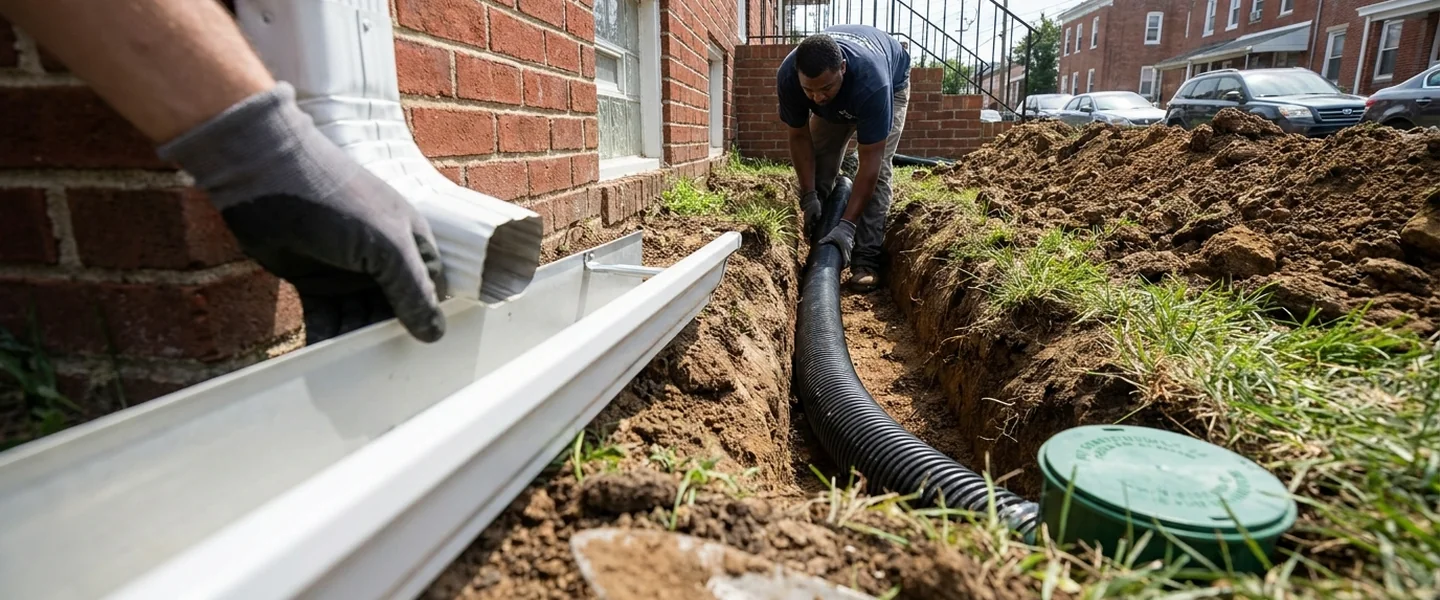
When site conditions don't allow adequate surface discharge — typically because the yard is flat, slopes toward the house, or is too small to route a surface extension to a safe discharge point — underground drainage provides a robust solution. We install perforated or solid drainage pipe from the downspout termination to a suitable discharge location, which may be a daylight point at the low edge of the property, a catch basin, or a dry well.
Underground systems are particularly valuable for Baltimore's older rowhome neighborhoods, where lots are narrow and the only viable discharge direction is through a tight side yard. A buried 4-inch PVC drainage line running from the rear downspouts to a discharge point at the front or side of the property handles virtually any rainfall event without the visual clutter of surface extensions.
Dry Well Systems
When a natural discharge point isn't available — common on larger suburban lots in Pikesville and Owings Mills with tight property boundaries — a dry well provides an underground infiltration chamber that receives the downspout discharge and slowly releases it into the surrounding soil. Properly sized for the roof area and soil permeability, a dry well can handle the entire discharge from a residential roof during most storm events without surface overflow.
We don't install dry wells in Baltimore's clay-heaviest soil profiles without careful capacity calculations. In high-clay soils, a dry well that's too small will fill and overflow just as the storm is intensifying — the worst possible outcome. When clay content is high, we prefer a combination approach: a partial dry well with an overflow connection to a daylight discharge point.
Addressing Downspout Connections to Underground Drains
Many older Baltimore homes have downspouts connected to the original underground drain system, which may tie into the home's foundation drainage tile or, in some cases, directly into the storm sewer system. These original underground connections are frequently corroded, root-infiltrated, or completely failed — meaning the downspout appears to discharge underground, but is actually just pooling at the disconnected pipe joint below grade and seeping toward the foundation.
We inspect all underground downspout connections as part of our estimate process. When existing underground connections are suspect, we can camera-inspect the drain line or simply disconnect the underground tie-in and install a surface or new underground extension that we know functions correctly.
Frequently Asked Questions
We recommend a minimum of six feet in most Baltimore soil conditions. On sites with high clay content, heavy grade toward the house, or basement water history, ten feet or more is preferred. The on-site estimate will determine the appropriate distance for your specific property.
They can be a significant contributing factor. If the water intrusion is driven by hydrostatic pressure from saturated foundation-perimeter soil — which is very common in Baltimore's clay-soil neighborhoods — properly extended downspouts combined with correct grading can eliminate or dramatically reduce basement moisture. We're honest if we think the problem requires additional foundation waterproofing work.
Ground trenching is limited by frozen soil conditions, but in Baltimore's climate, truly frozen ground is intermittent. Most underground drain installations can proceed through the fall and into early winter before ground freezing becomes a constraint.
Stop Water From Reaching Your Foundation
Call Baltimore Gutter Experts for a free drainage assessment. We'll evaluate your current downspout discharge, soil conditions, and basement history to recommend the right extension approach for your home.
Call (443) 339-6431 — Free Estimate